Parents often wonder about the ideal duration for bouncing activities when their children visit indoor playgrounds. With the growing popularity of trampolines, bouncy castles, and soft play zones, knowing the safe time limits for each age group helps prevent injuries while maximizing the fun. At KartTown in Scarborough, we’ve created age-appropriate bouncing zones where 794+ families trust us to keep their little ones safe while they jump, play, and burn off energy.
The right bouncing duration depends on your child’s age, physical stamina, and the type of equipment they’re using. Too little time and kids don’t get enough exercise; too much and they risk overstimulation or fatigue-related accidents.
Why Bouncing Time Matters for Young Children
Bouncing activities offer tremendous developmental benefits for kids aged 2-9, including improved coordination, balance, and cardiovascular health. However, these same benefits can turn into risks if children bounce for too long without proper breaks.
Young bodies tire faster than adults realize. A toddler’s muscles and bones are still developing, making them more susceptible to strain injuries from prolonged jumping. Additionally, the excitement of bouncing can mask early signs of exhaustion, leading children to push themselves beyond safe limits.
Key factors affecting safe bouncing duration:
- Age and developmental stage
- Physical fitness level
- Type of bouncing equipment
- Temperature and ventilation
- Hydration status
- Number of children sharing the space
Indoor play centers like KartTown prioritize these factors by maintaining comfortable temperatures, ensuring proper supervision, and creating designated zones for different age groups. Our new bouncy castle, included with admission, provides a safe environment where parents can monitor their children’s activity levels closely.
Recommended Bouncing Duration by Age Group
Every age group has different physical capabilities and attention spans. Following research-backed guidelines helps ensure children enjoy bouncing activities without risking injury or excessive fatigue.
Toddlers (Ages 2-3): Short and Supervised Sessions
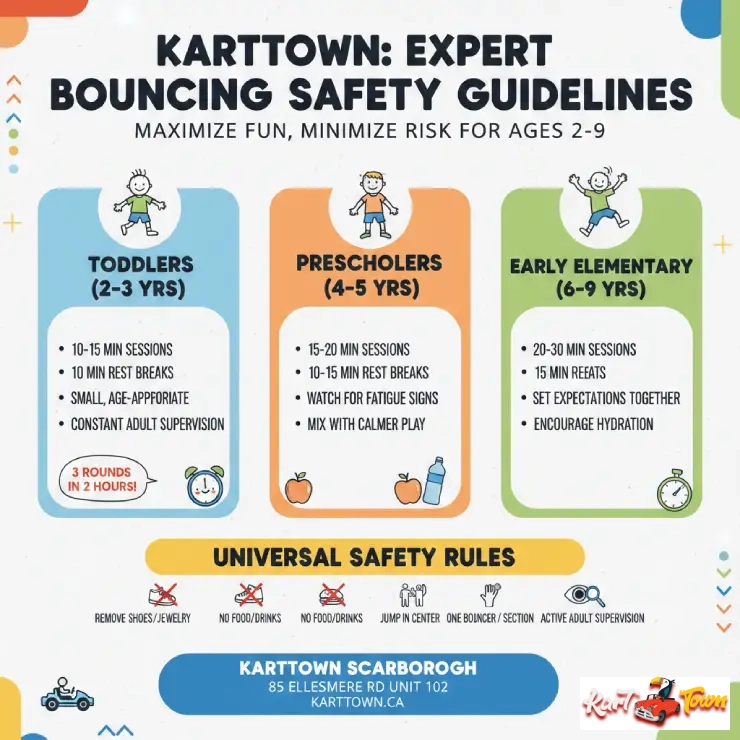
Toddlers should bounce for 10-15 minutes at a time with mandatory rest breaks in between. At this age, children are still mastering basic motor skills and have limited stamina.
Best practices for toddlers:
- Never leave them unsupervised, even for a moment
- Watch for signs of dizziness or loss of balance
- Limit bouncing to smaller, age-appropriate equipment
- Ensure no older children are bouncing simultaneously
- Keep sessions to 10-15 minutes, followed by 10-minute rest periods
Many parents find success with the “three rounds” approach: three 10-minute bouncing sessions spread across a 2-hour visit. This gives toddlers time to explore other activities like our toy car area while recovering their energy.
Preschoolers (Ages 4-5): Building Stamina Safely
Preschoolers can handle 15-20 minute bouncing sessions before needing a break. Their improved coordination and strength allow for slightly longer play periods, but supervision remains essential.
At this age, children start to recognize when they’re getting tired, though they may ignore these signals in the excitement of play. Parents should watch for decreased jumping height, stumbling, or complaints about being thirsty as indicators that a break is needed.
Recommended schedule for preschoolers:
- First session: 15-20 minutes of bouncing
- Rest break: 10-15 minutes with water and quiet play
- Second session: 15-20 minutes of bouncing
- Extended break: 20-30 minutes exploring other attractions
- Optional third session: 10-15 minutes if energy permits
Our playground includes multiple activities beyond bouncing, making it easy for kids to naturally transition between high-energy and calmer pursuits. This variety helps prevent both physical exhaustion and boredom.
Also Read: 10 Bouncy Castle Games Kids Love at Indoor Playgrounds
Early Elementary (Ages 6-9): Extended Play with Breaks
Children aged 6-9 can safely bounce for 20-30 minutes per session before requiring rest. Their improved endurance and body awareness make longer sessions appropriate, but regular hydration and rest remain important.
School-age children often want to challenge themselves and may resist taking breaks. Setting clear expectations before play begins helps: “We’ll bounce for 25 minutes, then take a water break, okay?”
Optimal bouncing schedule for ages 6-9:
- Initial session: 20-30 minutes of active bouncing
- First break: 15 minutes for water and arcade games
- Second session: 20-25 minutes of bouncing
- Lunch or snack break: 30-45 minutes
- Final session: 15-20 minutes before transitioning to other activities
For families celebrating birthdays, our birthday party packages naturally incorporate these break periods with food service and arcade time built into the schedule.
Safety Guidelines for Indoor Playground Bouncing
Beyond time limits, several safety factors ensure children enjoy bouncing activities without incident. These guidelines apply to all ages and all types of bouncing equipment.
Essential safety rules:
- Remove shoes, jewelry, and items from pockets
- No food, drinks, or gum while bouncing
- Jump in the center of the surface, away from edges
- One bounce style at a time (no mixing flips with regular jumping)
- Land on two feet when possible
- Exit immediately if feeling dizzy, nauseous, or overly tired
Adult supervision means actively watching, not checking phones or chatting with other parents. Position yourself where you can see your child’s face to catch early signs of fatigue like flushed cheeks, heavy breathing, or glazed eyes.
Rest Breaks and Hydration Requirements
Proper hydration prevents many bouncing-related issues. Children lose significant fluids through sweat during jumping activities, even in climate-controlled environments.
Hydration guidelines by age:
- Ages 2-3: 4-6 oz of water every 20 minutes
- Ages 4-5: 6-8 oz of water every 20-25 minutes
- Ages 6-9: 8-10 oz of water every 25-30 minutes
Offer water during rest breaks, not while bouncing. Most children won’t feel thirsty until they’re already slightly dehydrated, so don’t wait for them to ask.
Rest breaks should include sitting or very light activity. Walking around the facility, playing quieter arcade games, or sitting in the party room all qualify as appropriate rest activities. The goal is to lower heart rate and body temperature while maintaining engagement.
Warning Signs Your Child Needs a Break
Even with scheduled breaks, some children need to stop bouncing earlier than planned. Watch for these red flags:
- Excessive sweating or flushed face
- Complaints of dizziness or headache
- Decreased coordination or stumbling
- Sitting down on the bouncing surface
- Rubbing eyes or appearing disoriented
- Unusual irritability or emotional responses
- Difficulty following simple instructions
If you notice any of these signs, guide your child off the bouncing equipment immediately. Offer water, find a quiet spot to sit, and allow at least 15-20 minutes of complete rest before considering a return to active play.
Some children push through discomfort to keep playing with friends. Don’t hesitate to enforce breaks even if your child protests. A 15-minute timeout now prevents a potential injury or meltdown later.
Also Read: Host a Successful Birthday Party at an Indoor Playground in Toronto
How KartTown Ensures Safe Bouncing for Every Child
At our Scarborough location inside Parkway Mall (85 Ellesmere Rd Unit 102), we’ve designed our facility with age-appropriate safety in mind. Our 794 Google reviews reflect families’ trust in our commitment to both fun and security.
Our new bouncy castle features high walls, netted sides, and a cushioned landing area. Unlike backyard inflatables, our commercial-grade equipment undergoes daily safety inspections and follows strict capacity limits to prevent overcrowding.
Safety features at KartTown:
- Age-separated play zones
- Non-slip surfaces throughout
- Constant staff supervision
- Regular equipment maintenance
- Clear capacity limits posted
- First aid-trained staff on duty
- Climate-controlled environment
- Sanitization between sessions
Parents receive colored wristbands matching their children’s bands, ensuring no child leaves with the wrong family. This system, combined with our 2-hour access windows, helps families pace their visit appropriately without feeling rushed.
Age-Appropriate Zones and Equipment
We’ve designated specific areas for different age groups to prevent collisions between toddlers and older, more energetic children. Our bouncy castle welcomes kids of all sizes within our 2-9 age range, but staff actively manage the flow to maintain safe ratios.
Toddlers 31 inches tall and up can enjoy softer play structures and our toy car area, where they can pretend-drive without the physical demands of constant bouncing. This variety keeps them engaged for the full 2-hour access period without overstressing their developing bodies.
Older children gravitate toward our go-kart track and arcade games, naturally mixing high-energy and moderate activities throughout their visit. Kids 43 inches or taller can drive our Classic Karts solo, giving them an exciting alternative when they need a break from bouncing.
For families interested in group activities or field trip opportunities, we offer structured schedules that incorporate bouncing time limits appropriate for classroom-sized groups.
Trained Staff Supervision Standards
Every KartTown team member undergoes safety training specific to children’s play equipment. Our staff monitors bouncing areas continuously, watching for:
- Overcrowding on any single piece of equipment
- Children showing signs of fatigue
- Inappropriate bouncing techniques
- Equipment malfunction or safety concerns
- Conflict between children
Staff members are empowered to enforce break times and redirect children to other activities when necessary. Parents appreciate this additional layer of oversight, especially when managing multiple children or celebrating a birthday party.
Our activity coordinators, included with birthday packages, help pace the party schedule to include appropriate rest periods. They announce transitions between activities, ensuring kids don’t bounce for dangerous lengths of time without realizing it.
Maximum Benefits, Minimum Risks: The Science Behind Bouncing
Bouncing activities provide measurable developmental benefits when done correctly. Research shows that controlled jumping improves bone density, strengthens muscles, and enhances vestibular system function in growing children.
The vestibular system, responsible for balance and spatial orientation, develops rapidly between ages 2-9. Regular bouncing stimulates this system, contributing to better coordination and body awareness. However, overstimulation leads to dizziness and disorientation, which is why time limits matter.
Physical benefits of age-appropriate bouncing:
- Cardiovascular conditioning without high impact on joints
- Improved core strength and stability
- Better bilateral coordination (using both sides of the body)
- Enhanced proprioception (awareness of body position)
- Increased bone density in weight-bearing bones
- Better lymphatic system function and circulation
These benefits accumulate over time with regular, moderate sessions rather than single marathon bouncing periods.
Physical Development and Energy Release
Young children have enormous energy reserves that need healthy outlets. Bouncing provides intensive physical activity in a confined, safe space, making it ideal for indoor play centers.
A 30-minute bouncing session can burn 150-200 calories for school-age children, equivalent to running at moderate pace. This energy expenditure helps regulate mood, improve sleep patterns, and promote healthy appetite, all while developing crucial motor skills.
Parents often notice their children are calmer and more focused after visiting our facility. This isn’t coincidental—physical activity releases endorphins and helps regulate neurotransmitters associated with attention and mood stability.
Combining bouncing with other activities at KartTown, like our arcade or go-karting, provides balanced stimulation. Children exercise different muscle groups, prevent repetitive strain, and maintain engagement longer than they would with only one activity type. To learn more about how varied play supports development, check out our guide on developmental benefits.
Avoiding Overstimulation and Fatigue
While bouncing offers many benefits, excessive sessions can lead to sensory overload, particularly in younger children or those with sensory processing differences. Signs of overstimulation include hyperactivity, emotional outbursts, or sudden exhaustion.
The bright colors, movement, and social interaction inherent in bouncing activities provide rich sensory input. For most children, this is engaging and enjoyable. However, without adequate breaks, the constant stimulation becomes overwhelming.
Warning signs of overstimulation:
- Increased emotional volatility (sudden tears or anger)
- Difficulty transitioning between activities
- Covering ears or eyes
- Withdrawal from social interaction
- Hyperactive behavior or inability to calm down
- Complaints of feeling “weird” or uncomfortable
When you observe these signs, move to a quieter area of the facility. Our party rooms, available with birthday packages, provide perfect calm-down spaces. Even without a party reservation, parents can step into less crowded areas like the entrance lobby for a sensory break.
Preventing overstimulation starts with following recommended time limits and watching your individual child’s responses. Some kids naturally regulate well; others need more parental guidance to recognize when they’ve reached their limit.
Planning Your Visit to KartTown Scarborough
Located inside Parkway Mall, KartTown offers convenient access with ample parking and proximity to shopping and dining. Our facility welcomes walk-ins on a first-come, first-served basis, with no advance booking required for regular play.
Our hours of operation:
- Monday: 2:00 PM – 8:00 PM
- Tuesday: CLOSED
- Wednesday: 2:00 PM – 8:00 PM
- Thursday: 2:00 PM – 8:00 PM
- Friday: 2:00 PM – 8:00 PM
- Saturday: 10:00 AM – 8:00 PM
- Sunday: 10:00 AM – 8:00 PM
- Public holidays, school holidays & TDSB PA days: 11:00 AM – 8:00 PM
We recommend arriving early on weekends and holidays, as our 2-hour access windows fill quickly during peak times. Weekday afternoons typically see lighter crowds, making it easier to monitor your child’s bouncing time and ensure they get adequate turns on all equipment.
What to Expect at Our Indoor Playground
Upon arrival, you’ll check in at reception where staff will fit your group with matching wristbands. Every child needs to purchase a bundle or ride ticket on each visit to access the facility—tickets and tokens are valid same-day only.
Our facility includes multiple activity zones beyond the bouncy castle:
- Classic Karts track for ages 2-9
- Arcade games (1 token per game per player)
- Playground structures with slides and climbing elements
- Toy car area for younger visitors
- Party rooms (reserved for birthday celebrations)
Up to 2 adults can enter per child at no charge. Additional adults are charged separately. This generous policy means both parents, or a parent and grandparent, can supervise together.
All visitors must complete a waiver before participating in activities. You can fill out the waiver in advance online to save time at check-in.

Combining Bouncing with Other Activities
The beauty of KartTown’s multi-activity format is that children naturally pace themselves when given options. After 15 minutes of bouncing, kids often gravitate toward the go-karts or arcade without prompting.
Our bundles include both playground access and go-kart rides, encouraging this variety. The Basic Package provides 2-hour access plus 1 adventure (approximately 10 laps of go-karting) and 5 arcade tokens. The VIP Package upgrades to 2 adventures and 10 arcade tokens, giving kids more built-in transitions between activities.
For families planning to spend the full 2-hour access window, we recommend this rotation:
- Start with 15-20 minutes of bouncing while energy is highest
- Transition to go-karts for a seated but exciting activity
- Take an arcade break with remaining tokens
- Return to bouncing for a second 15-20 minute session
- Finish with free play in the toy car area or additional go-kart rides
This schedule naturally incorporates rest periods without children feeling like they’re missing out. The seated activities (go-karts and most arcade games) provide active rest where heart rate lowers while engagement remains high.
Parents celebrating birthdays will find that our party packages already structure time this way, with activity coordinators managing transitions so you can enjoy the celebration. To explore our celebration options, book your visit or call us at (437) 660-5278.
FAQ
How long should toddlers bounce at indoor playgrounds?
Toddlers ages 2-3 should bounce for 10-15 minutes maximum per session, followed by at least 10 minutes of rest. Their developing muscles and limited stamina require shorter, supervised sessions with frequent breaks.
Can kids bounce for 2 hours straight?
No, children should not bounce continuously for 2 hours. Even older kids (ages 6-9) need rest breaks every 20-30 minutes to prevent exhaustion, dehydration, and injury from fatigue-related accidents.
What happens if my child bounces too long?
Excessive bouncing can cause dizziness, muscle strain, dehydration, or overstimulation leading to behavioral issues. Watch for warning signs like flushed face, stumbling, or emotional changes, and enforce breaks when they appear.
Is the bouncy castle included with admission at KartTown?
Yes, our new bouncy castle is included with all admission packages at no extra charge. All bundles provide 2-hour access to the playground, including the bouncy castle, toy car area, and play structures.
How many times can kids bounce during a 2-hour visit?
Most children safely complete 2-3 bouncing sessions during a 2-hour visit: two 15-20 minute sessions for younger kids, or two 20-30 minute sessions for older children, with adequate rest breaks between each session.
Visit Scarborough’s Trusted Indoor Play Center Today
Now that you know the safe bouncing durations for your child’s age group, you’re ready to plan a visit that maximizes fun while minimizing risks. At KartTown, our combination of age-appropriate equipment, trained staff supervision, and multiple activity options makes it easy to follow expert guidelines without restricting your child’s enjoyment.
Our 794 Google reviews reflect families’ confidence in our safety standards and engaging environment. We’ve welcomed thousands of children through our doors, each one experiencing the perfect balance of active play, structured rest, and developmental benefits.
Why families choose KartTown:
✅ Commercial-grade equipment with daily safety inspections
✅ Age-separated zones for safer play
✅ Staff-enforced capacity limits
✅ Climate-controlled comfort year-round
✅ Multiple activities for natural pacing
✅ Convenient Parkway Mall location
✅ 30% discount on birthday party packages
Ready to experience safe, supervised bouncing in a facility designed specifically for ages 2-9? Visit us inside Parkway Mall at 85 Ellesmere Rd Unit 102, Scarborough. Walk-ins are welcome during all operating hours, or contact our team to discuss birthday party options for groups under 8 children.
Give your child the gift of healthy, joyful movement in an environment where safety comes first and fun comes naturally. We’ll see you at KartTown!